TL;DR: ATYP is a Slovak furniture workshop in Bánovce nad Bebravou, a town of about 15,800 people in Slovakia's Trenčín region. The whole production loop sits under one roof. 3mm cold-rolled steel is cut on a CNC plasma table, welded by hand, then powder-coated to a customer-chosen RAL code before each piece ships across the EU.
ATYP runs a small Slovak furniture workshop on the western edge of Bánovce nad Bebravou, a quiet manufacturing town of about 15,800 people in Slovakia's Trenčín region. The address is unremarkable. The work is custom metal furniture. Most of it starts as 3mm cold-rolled steel and ends as configurable wall hardware. Pieces include the KANSO Towel Holder in Graphite, the TONE Shelf with Hooks in Chalk, and our simplest object, the CORE Wall Hook in Slate. Everything ships under our 5-Year Craftsmanship Guarantee. Almost every order is powder-coated to a RAL code chosen by the customer, with most pieces shipping inside a 5 to 10 business day window.
Where the workshop is, and why the geography matters
Bánovce nad Bebravou sits between the Strážov Hills and the Považský Inovec range, roughly two hours from Vienna and three from Budapest. The town's industrial history is mostly trucks and textiles, with a long tail of small machining. After 1945, metalworking know-how built up here from the truck plants that grew out of the Tatra and later Tanax lines. Today, steel suppliers and powder coaters sit within a 30-minute drive of the workshop. So do a handful of machining shops. A small studio can keep its supply chain physically close.
That matters. When a sheet of steel needs to be re-cut because a customer changed a length from 60 cm to 73 cm, we want it back in the welding bay the same day. Configuration only works when the loop is short.
What's actually on the workshop floor
The shop is a single building. Materials sit on the south wall: rolls of mild steel sheet, mostly 3mm and 5mm, with a smaller stack of stainless for parts that face permanent moisture. From the loading door inward you pass a cutting cell, a welding bay, a sanding area, and a powder-coat booth. Hooks and brackets get cut first in the morning. Shelves and longer pieces come second. We hold less than a week of stock by design.
You can hear the room from outside. Plasma cutting and hand grinding. The extraction system hums under it all. Nothing about it is photogenic in a brand-film way. It is a fabrication shop, and it sounds like one.
From a configured order to a packed box
The cut
Every order arrives as a parameterized file: dimensions, color, mounting type. The CNC plasma cuts flat shapes from sheet stock. A 37 cm KANSO Towel Holder bar and a CORE Wall Hook can come off the same sheet on the same morning.
The weld
Two welders work the bay. TIG for visible joints. MIG when the seam will sit behind a wall mount. We don't grind welds smooth to fake a continuous surface. The weld lines stay visible on the back of pieces like the TONE Shelf with Hooks because the back faces the wall.
The finish
After welding, parts go through a wash and a phosphate pre-treatment. This is the step most workshops skip when they cut corners. Without it, powder coat eventually flakes. With it, the coat survives a decade of bathroom humidity. Powder is applied electrostatically inside the booth: the charged steel pulls dry pigment to its surface. Then the part bakes at around 200°C in a curing oven, which melts the pigment into a continuous polymer shell. For more on why we hold the line on 3mm stock, see our earlier piece on why we use 3mm cold-rolled steel.
The pack
Each piece is wrapped in recycled paper with foam corners, then boxed and labeled. Lead time from order to shipment sits between 5 and 10 business days for most configurations. Customers in Germany, Italy, France, Belgium, and the Netherlands see roughly the same window. The full process is documented on our production page.
How thick is the steel in ATYP shelves?
3mm cold-rolled mild steel for most wall pieces. Cold-rolled means the steel was reduced to its final thickness at room temperature instead of while still hot. The result is harder than hot-rolled stock and flatter, with a tighter dimensional tolerance. That tolerance matters for parts that need to sit perfectly flush against a wall. On heavier load-bearing shelves we step up to 5mm. On the small bathroom accessories, 2mm would be enough by load alone, but we default high so the visual mass reads as solid in the hand.
Why a workshop this size, and not bigger
Slovakia's broader furniture industry leans on large factories supplying flat-pack, ready-to-assemble exports to Germany and Austria. That model works when the unit is identical across a 10,000-piece run. It does not work for furniture where the customer chose the width and the RAL code.
We stay small on purpose. The whole production line sits in one building so a single fabricator can walk a piece from cut to box. Mistakes get caught at the next station. Custom changes don't need a meeting. The trade-off is volume. We don't run discount sales because there is no warehouse to clear. Configuration is documented on our customization page.
Three pieces that explain the workshop
CORE Wall Hook
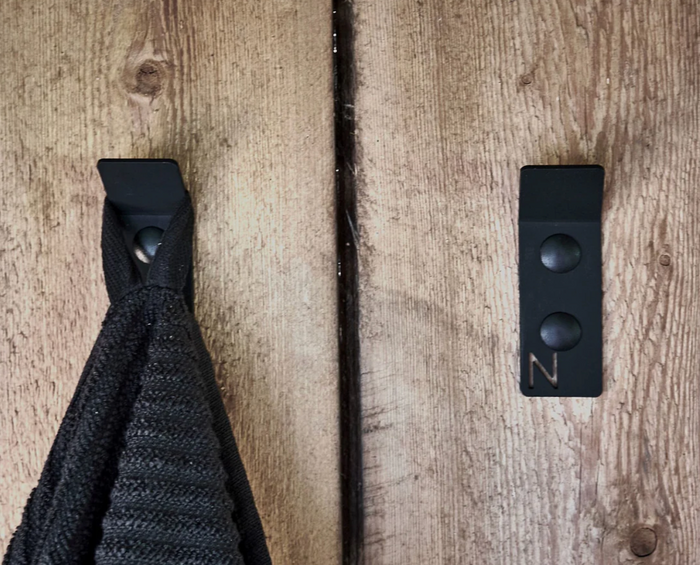
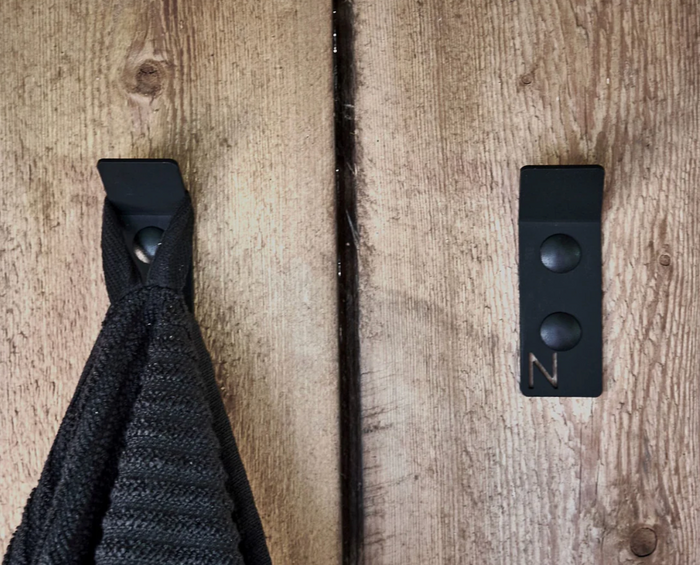
The simplest thing we make. One bent piece of 3mm steel, powder-coated, available in Chalk, Graphite, or Slate, with a choice of screw or tape mount. It is the piece we usually point first-time buyers to.
KANSO Towel Holder
A single horizontal bar in S (37 cm), M (60 cm), or L (97 cm). It earns its wall by holding a hand towel without bracketry or a hinge. The KANSO is what taught us how much the visible weld matters. A sloppy fillet would show every time the bar caught morning light.
TONE Shelf with Hooks
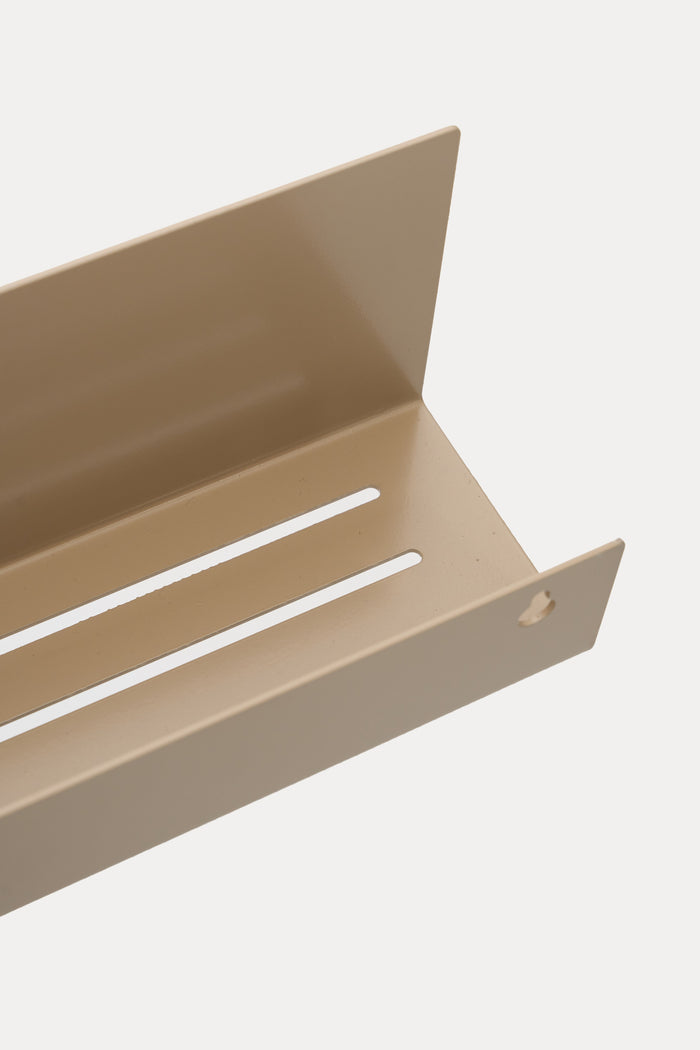
A shelf and a row of hooks welded into one piece. The 60 cm size carries a heavy bag and a stack of books at the same time. The hooks line up under the shelf rather than on top, so the surface stays clear for a lamp or a plant.
How to actually visit
We don't run regular public tours. Interior designers and hospitality buyers specifying ATYP in projects can request a workshop visit through the contact page. We also occasionally host commissioned designers in Bánovce for a half-day during a project design cycle. Most customers see the workshop only through what arrives in the box, which is by design. The story should be in the steel.
FAQ
How many people work in the ATYP Slovak furniture workshop?
A small team of fabricators and finishers, plus a packer and a coordinator. Production runs lean on purpose so a single person can walk a piece from cut to box, which keeps custom changes feasible without a long internal handover.
What is the lead time on a configured ATYP order?
Between 5 and 10 business days from order to shipment for most configurations. Larger pieces or non-standard finishes can extend that window by a few days. Lead times are listed on every product page.
Does ATYP offer in-person workshop tours in Bánovce nad Bebravou?
Not on a regular schedule. Interior designers and hospitality buyers can request a half-day visit through our contact page. We don't run public tours yet.
Why is ATYP based in Bánovce nad Bebravou specifically?
The town has a deep metalworking supply chain inherited from its truck and machining industries. Steel suppliers and powder coaters sit within a 30-minute drive of the workshop, which keeps the production loop short and configuration-friendly.
Where does ATYP ship from?
Every piece ships from the Bánovce nad Bebravou workshop to addresses across the EU, currently including Slovakia, Germany, Italy, France, Belgium, and the Netherlands.
ATYP is a Slovak design studio crafting custom metal furniture from a workshop in Bánovce nad Bebravou. Every piece is configured to order, hand-finished, and backed by our 5-Year Craftsmanship Guarantee.