TL;DR: ATYP builds every shelf, hook, and bracket in our catalogue from 3 mm cold-rolled steel, specifically EN 10130 DC01 plate. We picked it for three reasons: tighter tolerance than hot-rolled, better powder-coat adhesion, and roughly 20% higher tensile strength at the same thickness. Below is the reasoning, with specs.
Walk into our workshop in Slovakia, and the first thing you notice is the stack of steel plate against the wall. It is all one thickness: 3 mm. It is all cold-rolled. Every piece of custom metal furniture we ship, the AIKI Wall Hook, the METI Bathroom Shelf, the LUMO Livingroom Shelf, starts as a sheet pulled from that stack. Cut, formed, welded, and powder-coated to an exact RAL shade, but the substrate does not change. Cold-rolled steel furniture is the material spine of the brand, and 3 mm is the thickness we have settled on. This piece explains why.
What "cold-rolled" actually means
Steel is rolled to thickness in one of two ways. Hot-rolled steel passes through rollers above its recrystallization temperature, roughly 925 °C, and shrinks slightly as it cools, which loosens dimensional tolerances. Cold-rolled steel goes through the same rollers at room temperature, after the hot-rolling stage, in a series of careful passes. The result: tighter thickness tolerances, a smoother surface, and, through a process called strain hardening, measurably higher strength.
Specifically, we use DC01 grade per EN 10130, the European standard for cold-rolled low-carbon steel flat products intended for cold forming. Material number 1.0330. Carbon content capped at 0.12%. Minimum tensile strength in the 270 to 410 MPa band, minimum elongation 28%. None of those figures will mean anything to most readers, but they should reassure your contractor or interior designer. DC01 is the grade widely specified across the EU for cabinet metalwork, electrical enclosures, and structural shelving.
Why 3 mm, not 2, not 4
3 mm is not arbitrary. We tested into it.
Tolerance and flatness
Cold-rolled DC01 holds tighter thickness tolerances than hot-rolled equivalents and shrinks less during forming. Practically, this means a 3 mm plate on the LUMO Livingroom Shelf is genuinely 3 mm, not 2.7 mm in one corner and 3.2 mm in another. A wall-mounted shelf that does not sit flat against the wall is a defect we do not ship.
Load and rigidity
3 mm is the inflection point where a steel plate behaves like a structural surface, not a decorative facing. Industrial brackets fabricated from 3 mm cold-rolled plate are commonly rated to carry around 100 kg per bracket. A METI Bathroom Shelf in Graphite holds a stack of dense ceramic tiles or a cast-iron sink basin without measurable deflection. Below 3 mm we saw flex under load. Above 3 mm the visual proportions become heavy and every cut, weld, and bend gets more expensive. 3 mm is the strength-to-weight-to-cost sweet spot for the room-scale objects we make.
Strength margin
Cold-rolled steel is approximately 20% stronger in tensile terms than hot-rolled at the same thickness: typical tensile strength around 85,000 psi versus 67,000 psi, yield strength around 70,000 psi versus 45,000 psi. We design as if the strength advantage does not exist, then take the safety margin for free. That is the maker's idea of luxury: hidden surplus.
Cold-rolled and powder coat: a quiet partnership
Powder coating is the second material story. We finish every piece in one of five house RAL shades, Chalk, Linen, Slate, Umber, and Graphite, or any other RAL code on request, sprayed in our spray booth and oven-cured. The full sequence is documented on our Production page.
Here is the part most catalogue brands skip: a powder-coat finish is only as good as the substrate underneath it. Hot-rolled steel comes off the mill with a layer of mill scale, an iron-oxide film that has to be sandblasted, pickled, or ground away before powder can bond. Skip that prep and the coat flakes inside a year.
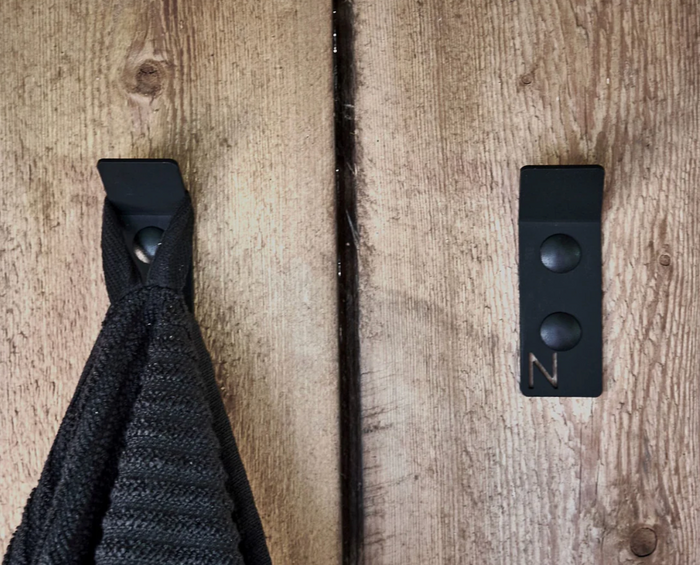
Cold-rolled steel arrives with a clean, scale-free, uniform surface. Powder bonds directly. The result is the matte, even tone you see on the AIKI Wall Hook in Graphite, no orange-peel texture, no flake risk under a household sponge. It is the substrate-level reason we can offer a two-year guarantee against finish failure, not only against structural welds.
Where 3 mm shows up in the catalogue
Three pieces show the same specification at three different scales.
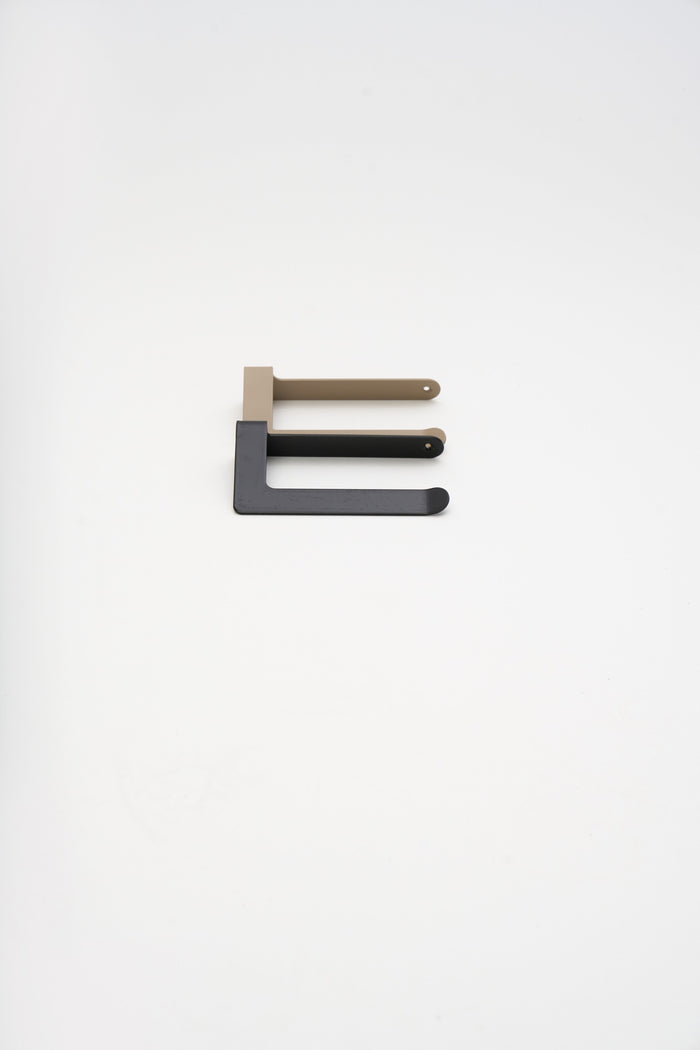
- The AIKI Wall Hook in Chalk, Graphite, or Slate, a 3 mm steel hook, screw or tape mount. The smallest expression of the spec, and a useful first piece if you want to see the finish in person before committing to a larger configuration.
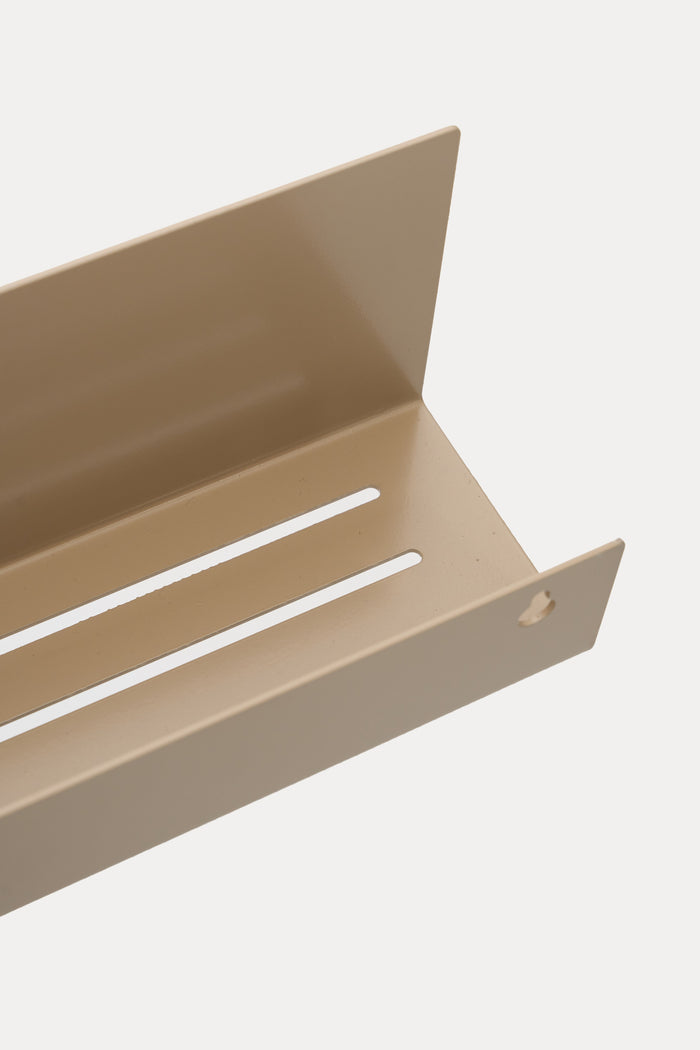
- The METI Bathroom Shelf, a 3 mm plate sized Small, Medium, or Large, with a perceptibly thin profile against the wall. The plate is structural, not a veneer bonded over MDF or plywood.
- The LUMO Livingroom Shelf, the longest configurable surface in our line, where the 3 mm thickness is the reason the shelf does not sag at full extension under a row of hardback books.
Configure any of them in any of the five house finishes on the product page, or in any RAL shade as a custom order, or start from a blank brief on Customize your furniture.
The trade-offs we accept
Cold-rolled steel costs more than hot-rolled per kilogram. The cold-rolling stage adds processing time, energy, and equipment cost. We pay for it. We also accept that DC01 is less ductile than hot-rolled equivalents, since strain hardening trades a portion of formability for strength, so our welders work to tighter heat-input parameters and quality control inspects every weld bead.
Compared to MDF, plywood, hollow aluminum, or thin galvanized sheet, the substrates most "metal" furniture is actually built from, 3 mm cold-rolled DC01 is overspecified. That is the point. For the broader argument on metal as a long-term material choice, see Metal Outdoor Furniture: Durable, Stylish Solutions.
Browse the full range in Bathroom Accessories or Living Room Accessories, or read what the material lets us guarantee on our Sustainability page.
FAQ
What is cold-rolled steel?
Cold-rolled steel is steel that has been rolled to its final thickness at room temperature, after a hot-rolling stage. The process tightens dimensional tolerances, produces a smooth scale-free surface, and increases tensile strength by roughly 20% through strain hardening. ATYP uses EN 10130 DC01 grade, material number 1.0330.
How thick is the steel in ATYP shelves?
3 mm. Every shelf, hook, and bracket in the ATYP catalogue starts from 3 mm cold-rolled DC01 plate. We chose 3 mm as the inflection point where a steel surface behaves structurally, flat, rigid, and low in deflection, without becoming visually heavy.
Why not stainless steel?
Stainless costs roughly three times more per kilogram and is rarely necessary indoors. Powder-coated DC01 is rust-resistant under normal interior humidity and bathroom conditions. We reserve stainless for site-specific commissions where chloride exposure is genuine: coastal, pool-adjacent, or commercial wet-room contexts.
Can cold-rolled steel be reliably powder-coated?
Yes, better than hot-rolled. Cold-rolled steel arrives with a clean, scale-free surface, so powder bonds directly without abrasive prep. That is the substrate-level reason our two-year guarantee covers the finish, not only the welds.
Will cold-rolled steel rust indoors?
No, provided the powder coat is intact. AIKI Wall Hooks installed in humid bathrooms have been observed at five years with no surface rust and no measurable color shift. Damage the finish and the underlying plate will eventually oxidize the same as any coated steel; re-coat or replace early.
ATYP is a Slovak design studio crafting custom metal furniture from a workshop in Slovakia. Every piece is configured to order, hand-finished, and backed by our two-year guarantee.
Written by ATYP for ATYP, custom metal furniture made in Slovakia.
Design your own